Fraud screening and deal orchestration.
One desk.▌
Deals done the right way.
DEALEXUS screens trade-finance instruments for fraud before a bank accepts them — and runs the deal that produces them.
A real person walks you through it — no bots, no sales script. 15 minutes, and if it isn't a fit we'll say so.
The 60-second
version.
What this business is · who is in the room · what goes wrong
A buyer in one country and a seller in another don't trust each other with a million dollars. So a bank stands in the middle. Almost everything in this business is about getting a bank to put that promise in writing — and there are really only three pieces of paper that matter.
Plenty of software already runs the stage inside the bank. Almost nothing runs the messy stage before it — the part where a deal is still being assembled and is not yet clean enough to hand over.
Who is in the room
Four kinds of people, up to six seats on a single deal — and every one of them can be cut out by the others.
What goes wrong
It is a $9.7 trillion market — and roughly $2.5 trillion of real trade, with real buyers and real goods, simply does not happen each year because the financing could not be arranged in time. Closer to home, it is the deal that died three weeks in.
That is the stage DEALEXUS runs. It screens the paperwork for fraud before it moves, and runs everything after that as one sequence — see how the screening works, or see the eight steps.
Know the paper
before it moves.
UPLOAD · CHECK · VERDICT
ARGUS pre-screens a trade-finance instrument and tells you — with receipts — whether it is safe to proceed. It is a pre-screen, not a compliance ruling: every finding traces to a rule and a source, it never accuses a party, and it never guarantees an outcome.
Drop an instrument — an SBLC, a letter of credit, or a SWIFT message. ARGUS reads it in your browser, and scanned instruments are read with OCR. No raw file leaves your device — only the extracted text and the matched identifiers are sent for analysis.
ARGUS runs deterministic checks against SWIFT field standards and a red-flag / sanctions corpus — BIC and IBAN conformance, instrument-field coherence, and identifier reuse. Reproducible rules, not a black box.
You get a verdict and a compliance score, with every finding cited to its source and a recourse path to resolve it. Your team confirms the outcome — ARGUS flags the risk, it does not rule on it.
Three layers of check. One cited verdict.
- BIC / SWIFT validity
- IBAN integrity
- MT field coherence
- Sanctions screening
- Identifier reuse
- Scheme-family typology
- Linguistic phrase flags
- Commodity spec profiles
- Flagged-entity match
- Cross-rail contamination
- Checksum validation
- Amount contradiction
- Identifier mutation
- Implausible balances
- Format conformance
A match exists in the record or it does not. Every finding names the rule it came from and the source behind it, so your own team can check the working rather than trust a score.
Every fabricated package that reaches a trade desk consumes enhanced due-diligence hours before it is rejected. A pre-screen does not replace that review — it tells the desk where to spend it.
Source: LexisNexis Risk Solutions, True Cost of Financial Crime Compliance
This industry runs on
broken infrastructure.
WHY DEALS FAIL BEFORE THEY CLOSE
Every week, trade finance deals worth millions collapse — not because the instruments are wrong, but because the process is wrong. The industry relies on WhatsApp groups, unverified email chains, documents forwarded to the wrong party, and commissions agreed on a handshake. DEALEXUS was built to fix this.
And none of it happens in a chat group. Every exchange runs through DEALEXUS — documented, sequenced, timestamped to UTC and signed against the deal ledger. No Zoom calls, no WhatsApp negotiations.
Eight steps.
One controlled workflow.
NO STEP SKIPPED · NO PARTY EXPOSED EARLY
- Steps 1–6 — NCNDA, KYC/CIS, DOA, IMFPA, Term Sheet and the bank submission package.
- Originate a deal, invite every party, protect commissions and produce a bank-ready package.
- Wizard, Deal Flow & Desk, and ARGUS document screening.
- Steps 7–8 — SWIFT transmission (MT760 / MT700 / MT103) and settlement.
- Neutral escrow and automated commission release at close.
- Gated on banking-partner and paymaster licensing — DEALEXUS holds no client funds today.
Every deal has a fixed
structure. Here is your seat.
PRINCIPALS · BROKERS · MANDATES · BANKERS
Whether you are a commodity trader financing bulk goods, a broker protecting a commission chain, a mandate acting for a principal, or a banker deciding whether an instrument is real — every party has a defined place. DEALEXUS routes documents and enforces the sequence so that no side can go around another. Each role has its own document set and its own access level.
The shape of a deal
Your seat, and what it needs
Sender or Receiver side. You sign the DOA directly. May appoint up to 1 Mandate. Your CIS goes to DEALEXUS only.
Requires Mandate Letter from your Principal. Without it, you cannot act as Mandate. Private IMFPA does not appear on the DOA.
Your IMFPA locks your commission from the start. Never cut out of the chain.
Pre-screen an instrument before it consumes review hours, and receive packages whose parties are already verified and whose drafts are generated to ISP98 / UCP600 / URDG758.
What moves where
See the actual
terminal.
Wizard → Funding roadmap → Deal flow
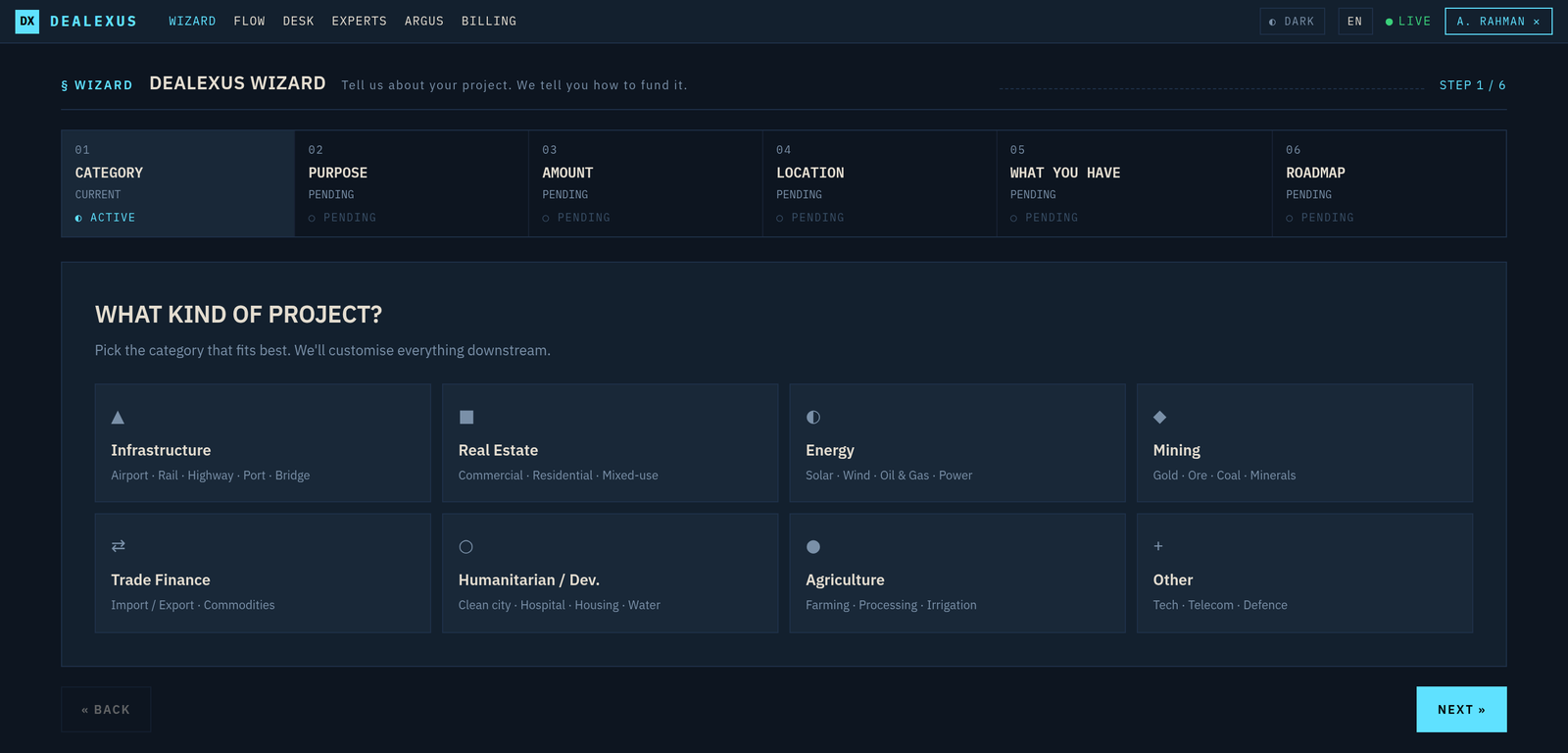
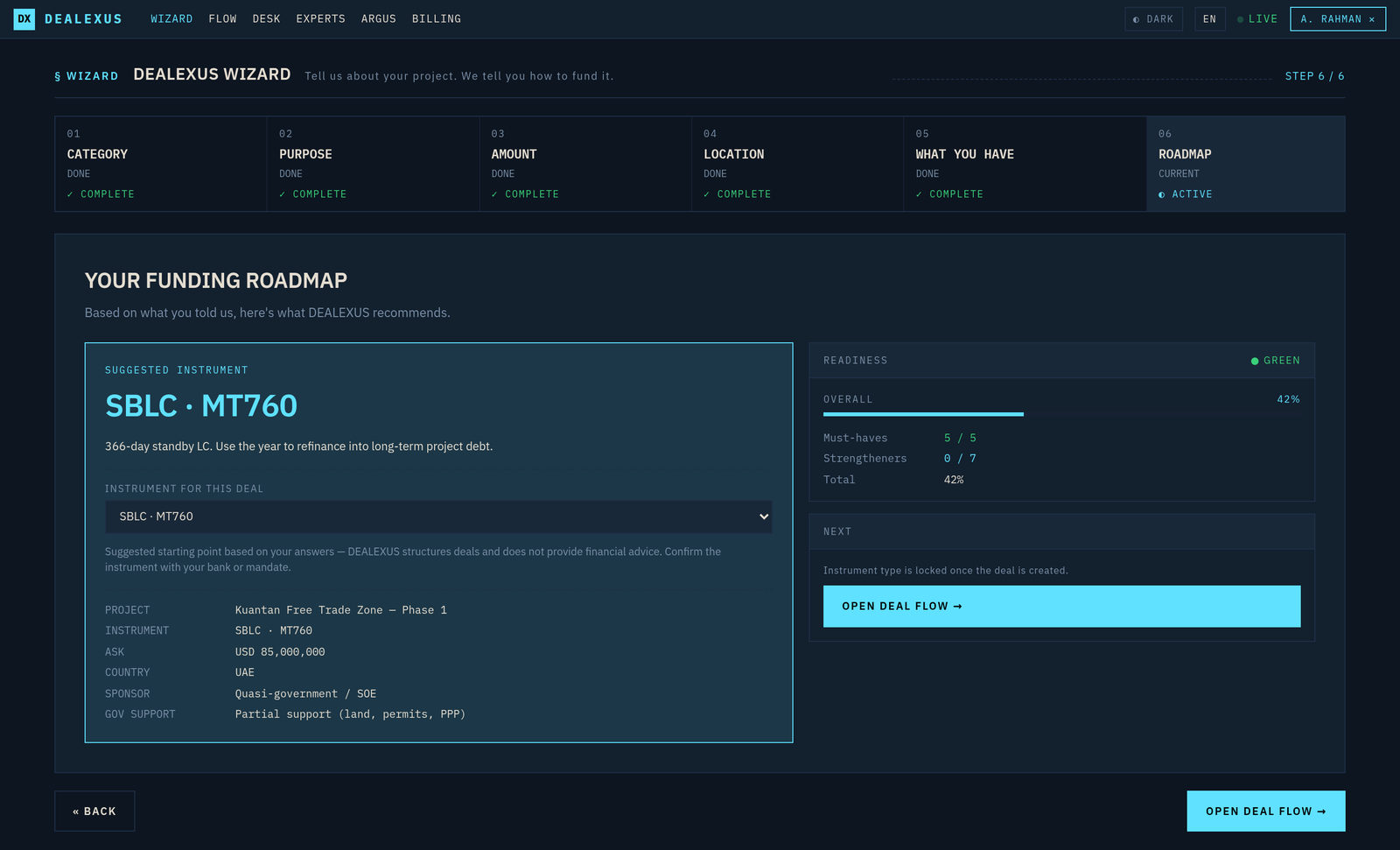
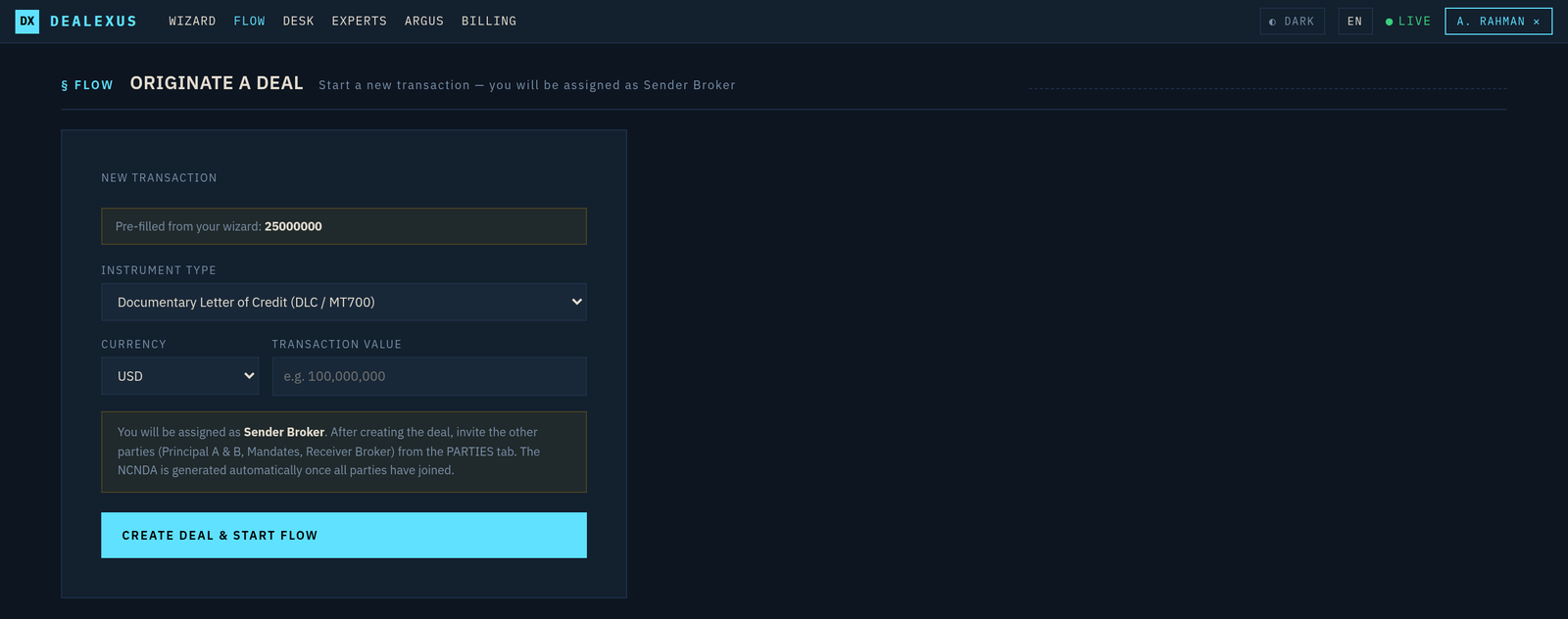
Most trade-finance platforms hide the product behind a login. These are real screens from the DEALEXUS terminal — not mockups. You tell the Wizard about your project; it recommends the instrument and scores your readiness; then Deal Flow originates the transaction and pulls every party into the right sequence.
Your commission is locked
before the deal moves.
IMFPA SIGNED AT STEP 4 · LOCKED BEFORE THE DEAL MOVES · YOU CANNOT BE CUT OUT
Every commission is calculated from the signed IMFPA and locked at step 4. No party can instruct DEALEXUS to alter or withhold a commission after the IMFPA is signed.
Principal A's side
Principal B's side
Principal A
Principal B
The verified desk before the bank.
Brokers and mandates get a credible, protected place to run a deal — commission locked before it moves. Principals get counterparties they can trust and a bank-ready submission package. Every deal is orchestrated through NCNDA, KYC, DOA, IMFPA, term sheet and bank submission — one controlled workflow. DEALEXUS orchestrates and tracks your deals — it does not close them for you and offers no closing guarantee.
Not ready to start? Book a 15-minute walkthrough first.
MVP1 is live now — self-serve checkout opens soon. Join the founding-member waitlist and we'll onboard you in order; no card charged yet.
- ›NCNDA → KYC → DOA → IMFPA → term sheet → bank submission, one controlled workflow
- ›ARGUS document intelligence — drafting, review and redlines, metered in credits
- ›KYC / CIS collection and verification, counterparty never sees your documents
- ›Commission locked in a signed IMFPA before the deal moves
A single DEAL DESK month — your whole active pipeline under management — costs less than the counsel bill for one deal done the old way.
- Verified profile & badge — stand out from the noise
- Full deal room — NCNDA, DOA, IMFPA, term sheet, bank submission
- Non-circumvention — commission locked in a signed IMFPA
- ARGUS document intelligence — starter credits
- Neutral commission escrow, released on close (on the roadmap — MVP2)
- Everything in Access, plus:
- Counterparty KYB verification — trade with parties who are checked
- Information-barrier protection — your documents stay yours
- ARGUS document verification — monthly allowance
- Bank-ready submission package
- Priority support
- Everything in Deal Desk, plus:
- Unlimited active deals & bank packages
- ARGUS — pooled / custom credits
- Bank-side confirmation workflow (on the roadmap)
- White-glove onboarding, SLA & dedicated account manager
Verified, not self-declared. Principal (buyer/seller) status is earned through KYB and proof of authority — not picked from a dropdown — so counterparties can trust who they are dealing with. Brokers & mandates subscribe on Access; principals on Deal Desk. See full pricing →
Paymaster / fund holding: Not available. Neutral escrow and automated commission release at settlement are planned for MVP2. DEALEXUS currently holds no client funds and is not licensed as a money services business.
The products behind the plans
From people who lost deals
to a broken process.
We didn't come to trade finance from software. We came to it from the deals — the ones that should have closed and didn't, because a commission lived in a WhatsApp thread, a KYC pack went to the wrong inbox, or a bank package came back for a formatting error no one caught in time.
DEALEXUS is the platform we wish we'd had: neutral, sequenced, and built so the people doing the work can't be written out of it. We're a small team and we answer our own email — if something here doesn't hold up, tell us and we'll fix it.
— The DEALEXUS team · info@dealexus.com
The questions everyone
asks us first.
Can my counterparty see my KYC?
No. You submit your CIS to DEALEXUS, not to the other side. They only ever see one thing: ✓ Verified. Raw documents never leave us and are never forwarded.
What stops a principal from closing the deal and cutting me out?
Your IMFPA is signed and locked at step 4 — before the deal moves. The 45 / 45 / 5 / 5 split is on the record before anyone touches a term sheet, so you can't be written out after the fact.
Do I have to move my whole team onto this?
No. Each party subscribes for their own side of a deal. You bring who you need; your subscription covers you, not your counterparties.
Why is Access $99/mo and Deal Desk $1,000/mo?
Because the two sides are buying different things. Access is a verified channel for brokers and mandates — verified profile, the full deal room, and your commission locked in a signed IMFPA before the deal moves. It is deliberately small: people who aren't paid until a deal closes shouldn't carry the platform, so the rest of what they pay is a commission fee that applies only on closed deals. Deal Desk is for principals, who buy the expensive part — counterparty KYB verification, information-barrier protection, ARGUS document verification and a bank-ready submission package. Done the old way, one deal typically runs $9,000–37,500 in counsel, structuring-consultant and KYC costs; a Deal Desk month covers your whole active pipeline under management for less than the counsel bill on a single deal. Annual billing is $990 and $10,000 (two months free), and the first 50 desks hold founding pricing of $49 and $500 for 12 months.
Does DEALEXUS hold my money?
Not today. DEALEXUS holds no client funds and is not a licensed money-services business. Neutral escrow and automated commission release at settlement are planned for MVP2.
What actually happens on a 15-minute walkthrough?
A real person shows you a live deal on the terminal and answers your questions — no bot, no sales script. If it isn't a fit for how you work, we'll tell you.
Stop losing deals to
broken process.
YOUR COMMISSION IS LOCKED · YOUR KYC STAYS PRIVATE · YOUR DEAL CLOSES
A real person walks you through it — no bots, no sales script. 15 minutes, and if it isn't a fit we'll say so.